Every casino game is a maths equation with the answer already written: over time, the house keeps a fixed percentage of everything wagered. That percentage — the house edge — and its mirror image, RTP, are the most useful numbers in gambling. Understanding them won't make you win, but it will make your money last dramatically longer.
RTP and House Edge: Two Sides of One Number
RTP (return to player) is the share of total wagers a game returns as winnings over the long run. House edge is what's left: a 96% RTP slot has a 4% house edge. Three things to internalise:
- It's a long-run average over millions of rounds. Your Tuesday-night session can land anywhere.
- It applies to turnover, not your wallet. With a $100 bankroll on a 4%-edge slot, you don't lose $4 — you lose 4% of everything you cycle through, which with rebetting can consume the full $100.
- Small differences compound. Over $10,000 of turnover, a 92% slot expects to cost $800; a 97% slot costs $300. Same fun, $500 difference.
Game-by-Game Comparison
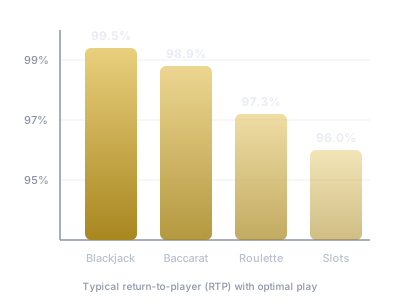
| Game | RTP | House Edge | Notes |
|---|---|---|---|
| Blackjack (basic strategy) | 99.5% | 0.5% | Requires playing every hand correctly |
| Crypto originals (Dice, Plinko) | ~99% | ~1% | Provably fair at Stake and similar |
| Baccarat (banker bet) | 98.9% | 1.06% | Zero decisions needed — the edge is fixed |
| Craps (pass line) | 98.6% | 1.41% | Side bets are much worse |
| European roulette | 97.3% | 2.7% | Single zero — always prefer over American |
| High-RTP slots | 96–97% | 3–4% | Check the info panel; RTP varies per title |
| American roulette | 94.7% | 5.26% | Double zero doubles the edge — avoid |
| Average / jackpot slots | 92–95% | 5–8% | Part of the "RTP" funds the jackpot pool |
One habit worth forming
Every online slot has its RTP in the in-game info panel. Checking it takes five seconds, and some providers ship the same slot in multiple RTP versions (96.5% / 94.5% / 92.5%) — casinos choose which to run. Two casinos can offer the identical game at different RTPs.
Volatility: The Missing Half of the Picture
Two slots with identical 96% RTP can feel completely different. Volatility (variance) describes how that 96% is distributed:
- Low volatility: frequent small wins, sessions hover near the average, bankroll erodes slowly and predictably. Best for long play sessions and bonus wagering.
- High volatility: long dry stretches punctuated by rare large hits. Most sessions lose; occasional sessions win big. Requires a bankroll that can survive the droughts.
Neither is "better" — they're different products. The mistake is playing high-volatility slots with a small bankroll and expecting low-volatility behaviour. Our volatility deep-dive covers how to read a slot's variance from its paytable.
Using RTP Strategically
- Match the game to the goal Longest playtime for your money: blackjack, baccarat or high-RTP slots. Chasing a life-changing hit: jackpot slots, accepting the worse odds as the ticket price.
- Clear bonuses on high-RTP, low-volatility slots Where permitted, this minimises expected cost during wagering — see the maths in our wagering guide.
- Always European over American roulette Same game, half the edge. There is no reason to ever play the double-zero wheel online.
- Learn basic strategy before playing blackjack The 99.5% RTP assumes correct decisions. Casual play without strategy runs closer to 97–98%. A strategy card is legal and takes minutes to use.
Frequently Asked Questions
What does RTP mean?
Which game has the best odds?
Does high RTP mean I'll win?
Emma covers casino game mechanics for AllCasinos365 — RTP, volatility and how individual slots, providers and table games work — with an emphasis on the Finnish and wider Nordic markets.